



In an era marked by war, economic fragmentation and intensifying geopolitical rivalry, regional organisations are under immense pressure.
Some are struggling to preserve internal cohesion.
Others are finding it difficult to reconcile competing national interests. A few have become increasingly vulnerable to external shocks.
Against this backdrop, Asean’s greatest strength is often overlooked. Its success does not lie merely in maintaining unity among its 11 member states.
Rather, Asean’s real strategic advantage lies in its ability to preserve regional cohesion while simultaneously building diplomatic platforms that engage the major powers of Asia and the wider Indo-Pacific.
This achievement becomes more apparent when Asean is compared with other regional organisations.
The European Union (EU) remains the world’s most advanced example of regional integration. It can have an intra regional trade of 67%.
Yet Brexit demonstrated that integration is not irreversible.
Differences over migration, fiscal policies, energy security and relations with Russia continue to challenge European cohesion.
The Gulf Cooperation Council (GCC) presents another instructive case.
Composed of six Arab monarchies sharing common linguistic, cultural and religious traditions, the GCC would appear to possess stronger foundations for unity than Asean. Yet reality has proven more complicated.
The diplomatic crisis involving Qatar between 2017 and 2021 exposed significant internal divisions. More recently, the conflict between the United States and Iran has placed new strains on Gulf unity.
While all GCC members seek regional stability, they do not always share identical approaches towards Iran, the United States or broader regional security questions.
Oman and Qatar have traditionally emphasised mediation and dialogue, while other Gulf states have adopted different strategic calculations.
The war has also exposed the vulnerability of Gulf economies to disruptions in energy markets and maritime routes.
The lesson is clear. Shared language, culture and religion do not automatically guarantee regional cohesion.
The South Asian Association for Regional Cooperation (Saarc) offers another example.
Despite immense economic and demographic potential, South Asia remains one of the least integrated regions in the world.
Political tensions among member states have often prevented the organisation from achieving its full potential.
The Organisation of African Union (OAU), meanwhile, continues to grapple with security crises, governance challenges and uneven development across a vast continent, currently worsened by the Ebola virus raging in the Congo.
Against this backdrop, Asean’s accomplishments deserve greater recognition.
When Asean was founded on Aug 8, 1967, Southeast Asia was hardly a region destined for success.
The Cold War was intensifying. Communist insurgencies threatened several governments.
Interstate tensions remained common. Economic development varied significantly among member states. Historical suspicions were widespread.
Many observers doubted Asean would survive.
Yet survive it did.
More importantly, it evolved into something far more consequential than its founders could have imagined.
One of Asean’s most significant achievements emerged from the Asian financial crisis of 1997.
Recognising the need for greater regional cooperation, Asean established the Asean Plus Three process, bringing together Asean, China, Japan and South Korea.
The significance of Asean Plus Three cannot be overstated. Potentially, Asean Plus Three can be the largest free market in the world.
Invariably, for the first time, East Asia’s principal economic powers were brought together within an Asean-led framework.
Despite historical grievances, territorial disputes and strategic competition among China, Japan and South Korea, Asean successfully created a platform that encouraged dialogue, cooperation and confidence-building.
Rather than allow Northeast Asia’s rivalries to dominate the regional agenda, Asean positioned itself as a neutral and trusted convenor.
This success encouraged Asean to expand its diplomatic architecture even further.
The Asean Regional Forum (ARF) emerged as the largest multilateral security dialogue platform in the Indo-Pacific.
Bringing together major powers, middle powers and smaller states, the ARF created opportunities for confidence-building, preventive diplomacy and regular strategic engagement.
Asean subsequently established the Asean Defence Ministers’ Meeting (ADMM), followed by the Asean Defence Ministers’ Meeting Plus (ADMM-Plus).
Through these mechanisms, Asean brought together defence establishments from the United States, China, Japan, South Korea, India, Australia, New Zealand and Russia.
Few regional organisations anywhere in the world can claim to convene such a broad spectrum of military powers within a single institutional framework.
The culmination of this diplomatic evolution was the East Asia Summit (EAS).
Today, the EAS remains one of the most important leaders-led forums in the Indo-Pacific. It brings together Asean and all the major powers of the region under an Asean-centred architecture.
In doing so, Asean transformed itself from a regional grouping focused on Southeast Asian stability into a central pillar of wider Asian diplomacy.
This is where Asean differs fundamentally from many other regional organisations.
Its strength does not derive from military power. It does not stem from economic coercion. Nor does it rest on supranational authority.
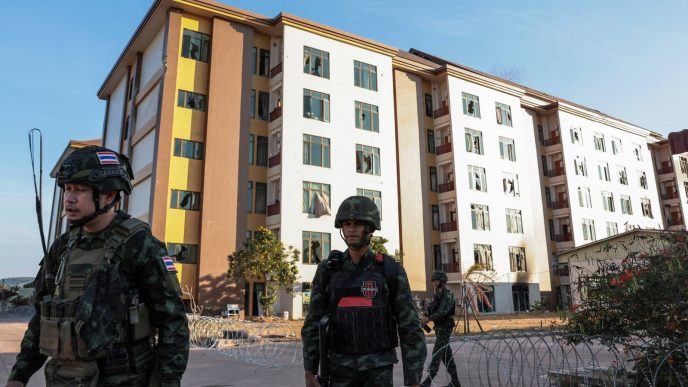
The Thai-Cambodian ceasefire, for example, is still holding; compared to the constant breakdowns of the ceasefires in West Asia currently.
Rather, Asean exercises what may be described as circumscribed power — the ability to shape regional interactions through light institutional legitimacy, diplomatic inclusiveness and strategic convening.
This capability has become increasingly important as geopolitical competition intensifies.
The rivalry between the United States and China continues to deepen. Conflicts in Ukraine and West Asia are generating economic uncertainties.
Emerging technologies such as artificial intelligence are reshaping global production and security. Supply chains are being reorganised. Energy and food security concerns are rising across the world.
Under such circumstances, Asean’s ability to provide a neutral platform for dialogue becomes a strategic asset not only for Southeast Asia but also for the wider Indo-Pacific.
To be sure, Asean is not without its shortcomings. Consensus-building can be slow.
Differences among member states remain significant. Challenges such as Myanmar, the South China Sea and economic disparities continue to test regional cohesion.
Yet the true measure of Asean’s success lies not in the absence of disagreements but in its ability to manage them peacefully while simultaneously engaging the world’s major powers.
Few regional organisations have managed to accomplish both.
As Asean approaches its sixth decade in 2027, its greatest contribution to international order may not just be confined to economic integration, such as the Regional Comprehensive Partnership Agreement (RCEP) or China Asean Free Trade Agreement (Cafta).
It is the creation of an enduring diplomatic architecture capable of bringing together countries that often disagree but nevertheless recognise the value of dialogue.
In a fragmented world increasingly defined by strategic competition, that achievement makes Asean not merely relevant, but indispensable.
The views expressed are those of the writer and do not necessarily reflect those of FMT.