


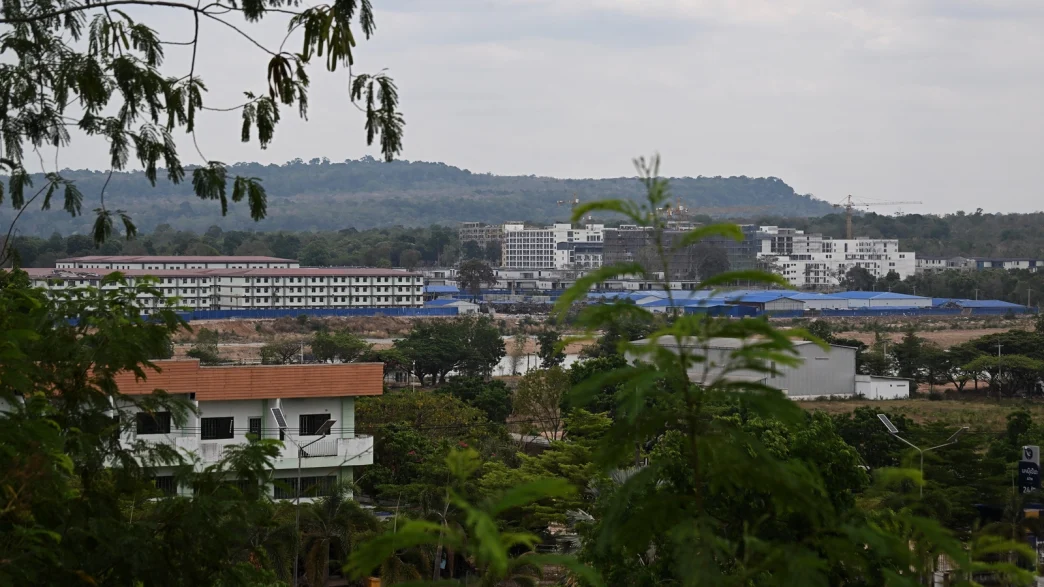
A view of abandoned scam centres from a hill in O’Smach town on the Thai-Cambodian border. (AFP pic)
O’SMACH: A gambling empire controlled by a powerful Cambodian tycoon was the landlord of a compound that was used for industrial-scale scamming and human trafficking operations, Reuters has found.
Lim Heng Group leased out buildings on grounds shared with one of its casinos on the Thai-Cambodian border at above-market rates, a rental agreement dated March 2024 seen by the news agency shows.
The structures housed rooms that had been transformed to look like police stations and bank offices from multiple countries – the backdrops for impersonation scams perpetrated on victims worldwide, according to interviews with the Thai military and people who worked in those buildings, as well as two visits by Reuters this year to the property.
Reuters is the first to report the details of Lim Heng Group’s commercial ties to buildings where scams were carried out, which were located just tens of metres away from its casino, Royal Hill.
The news agency found no evidence that Lim Heng Group was directly involved in the trafficking or fraud carried out at the site.
Royal Hill did not respond to phone calls and emails about cyberscam and trafficking activities at the property.
Reuters also sent Lim Heng Group questions by registered post, which was delivered but went unanswered.
Prosecutors can charge the landlords of scam compounds if investigations establish they know about criminal use of their property and allow it to continue, according to the independent Cambodian Human Rights Action Coalition and Piseth Duch, a Phnom Penh-based attorney who specialises in business and human rights law.
Lim Heng Group was put on notice of possible trafficking activities at Royal Hill by September 2024, when its representative filed a legal complaint against two Cambodian publishers whose outlets had reported that foreigners were being confined in the casino compound.
The court summonses over the “incitement to discrimination” complaints – both dated Sept 16 and seen by Reuters – did not specify the claims in the article that Lim Heng objected to.
One of the publishers, Penn Nuon, confirmed there had been a legal complaint related to the article about foreign nationals held at Royal Hill.
He said the reporting was accurate but that he had removed the article to settle the case after taking advice from his attorney.
Reuters couldn’t confirm if the complaint had been dropped. The Phnom Penh court where the complaints were filed did not respond to questions.
Gen Thatchai Pitaneelaboot of the Royal Thai Police, which is leading investigations into alleged cyberfraud at the compound, told reporters who were visiting the facility that Chinese gangsters perpetrated scams at the Royal Hill site, without providing specifics about their identity.
Thailand has established Lim Heng’s ownership of the site, according to two Thai security agency reports about Cambodian cyberfraud prepared this year and seen by Reuters.
Casino ties
Southeast Asia houses many factories of fraud, where mostly Chinese-led criminal gangs detain trafficking victims who are coerced into carrying out romance scams and police-impersonation fraud on targets.
The US government has estimated that Americans lost US$10 billion to fraudsters in the region in 2024.
Many Chinese-affiliated scam syndicate operators are also involved with casinos, which provide them with means to hide illicit gains, said Jason Tower of the Global Initiative against Transnational Organized Crime nonprofit.
In Cambodia, casino owners were “in direct control” of at least a dozen scam centres, according to an Amnesty International investigation based on gambling regulator records and witness testimony. Reuters has not independently confirmed these figures.
Cambodian casinos are often controlled by businesspeople with political connections, said Sophal Ear, a professor at Arizona State University who studies the kingdom’s politics.
Among them is Lim Heng: He has been photographed at social gatherings with senior generals and holds a royal title equivalent to a duke.
He also donated US$20,000 last year to Cambodia’s military, according to a business association which lists Lim Heng as a member.
The Cambodian government has pledged to eradicate scam centres.
However, it has repeatedly described Royal Hill as just a hotel, even as images of the fake police stations and banks found in the compound were broadcast by media around the world this year.
As part of an ongoing crackdown, the kingdom has extradited casino owner and alleged scamming kingpin Chen Zhi to China and passed legislation that directly targets scammers.
Chhay Sinarith, a senior Cambodian minister tasked with combating online fraud, said in response to Reuters’ questions that the government is committed to working with international partners to combat scams.
He added that the kingdom was investigating alleged fraud operations in the area around Royal Hill, but that Thai security forces should return custody of the locations they had seized to facilitate the probes.
The Cambodian military did not respond to questions about its ties with Lim Heng.
Pricey rent
Royal Hill casino is a faded structure of neoclassical columns and gold-rimmed spires metres from the Thai frontier.
It sits adjacent to the two buildings where Reuters found evidence of scam operations.
Those structures were among a group of buildings enclosed by a high fence topped with razor wire.
At least four of the fenced-off buildings were used for criminal activity, according to Thai security officials and Pornpen Aimhun, a Thai woman who said she was a trafficked worker at Royal Hill.
Reuters viewed the rental agreement between Royal Hill and a Chinese national at an office in one of the buildings, which the Thai military said appeared to have been used by scam bosses.
The lease said Royal Hill would rent three buildings in its compound to the Chinese national for two years at US$200,000 a month.
It was signed by the tenant and Seng Chanthy, then an employee of Royal Hill. Seng Chanthy didn’t return a request for comment about the contract.
Reuters is withholding the name of the tenant because the news agency was unable to independently confirm his identity or his role in the scam activity.
That price was extremely high for three buildings in a sleepy border town.
A mixed-use building in an upscale neighbourhood in the capital, Phnom Penh, of comparable size to the largest of the three Royal Hill structures was advertised in May for US$25,000 a month.
Reuters visited the casino compound in February and March at the invitation of the Thai military, which bombed Royal Hill during a brief border conflict with Cambodia in December.
The military, which now occupies the site, said it wanted to display evidence that Royal Hill was a scam facility.
Thailand said it had targeted Royal Hill because its troops had reported that the casino buildings in the area had been commandeered by Cambodian forces and were being used for drone and sniper attacks.
Cambodian information minister Neth Pheaktra told Reuters that those reports were false and that Thailand had attacked its civilian infrastructure.
The lease described the dimensions of two of the buildings and said that the third consisted of 252 rooms. It did not provide other identifying details.
The dimensions of three of the fenced-off structures matched the measurements in the contract, according to Bangladesh-based architect Rizvi Hassan, who reviewed satellite imagery of the buildings on Google Earth for Reuters.
The Thai military also told Reuters that its preliminary survey of the site indicated that two of the structures had approximately 250 rooms.
Fortified compounds
The US state department said in its 2024 human trafficking report that abuses in scam operations remained “widespread” in Cambodia because its elites owned properties used by scammers and financially benefited from such crimes.
“Scam centres require physical infrastructure, access to land, and a degree of protection to operate at scale,” said Ear, the Arizona State professor.
The scam operations in the border area were among the largest in Southeast Asia: Thai security forces say the fenced-off structures at Royal Hill housed about 3,000 people and formed part of a larger 200-acre scam park.
Among those who said they were trafficked to Royal Hill is Pornpen, who told Reuters she was lured there in 2022 by a Facebook advertisement for a web administrator job.
She was instead made to participate in a police-impersonation scheme before she escaped.
Guards with truncheons monitored workers, and those who failed to meet targets were punished, she said.
A spokesman for Facebook’s parent company, Meta, said the platform has designed warning messages that appear when users search for keywords that may be associated with fraudulent job posts.
Reuters corroborated Pornpen’s account with another person who said they were trafficked to Royal Hill and saw Pornpen there, as well as the Thai police, which said she was a witness in a court case about fraud conducted at the complex.
The court has since convicted a Thai national of voluntarily working as a low-level scammer at Royal Hill.
He was sentenced to five years’ imprisonment, according to a police statement on the verdict, which did not identify his employers or his lawyer.