


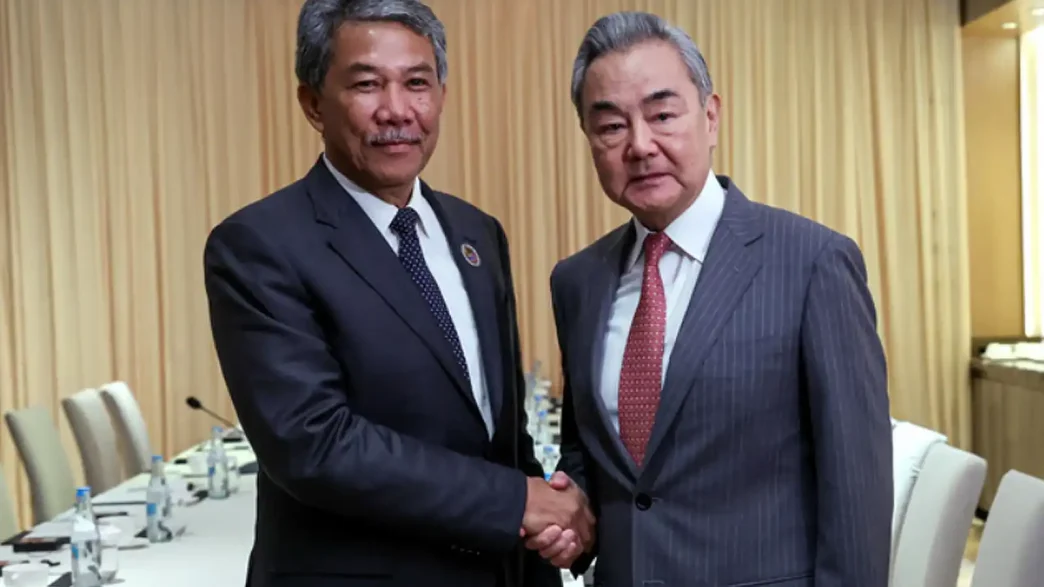
Mohamad Hasan with his Chinese counterpart Wang Yi after co-chairing the Asean-China Post-Ministerial Conference in Manila. (Bernama pic)
MANILA: The Code of Conduct (CoC) on the South China Sea is expected to be finalised at the 49th Asean Summit in Manila, scheduled for November.
Malaysia’s Foreign Minister Mohamad Hasan said the CoC, which serves as a framework to ensure the South China Sea remains a free, safe and accessible waterway for all, is currently at a stage where several key paragraphs still require the agreement of all countries involved.
“We will do our very best because finalising this is important for all Asean countries, particularly the Asean littoral states, which each have their own interests in the South China Sea.
“The CoC will serve as a guiding document for Asean countries and for nations that use the South China Sea, covering freedom of navigation, freedom of overflight and other related matters,” he told Bernama.
Mohamad said this after co-chairing the Asean-China Post-Ministerial Conference with his Chinese counterpart Wang Yi, in line with Malaysia’s role as the Asean-China Dialogue Relations Country Coordinator for the 2024-2027 period.
Meanwhile, Asean has urged the United States, in its capacity as a major global power, to play a more active role in de-escalating geopolitical tensions particularly in the Middle East, and to restore peace and reignite global economic growth.
Mohamad conveyed this message to US Secretary of State Marco Rubio during their Post-Ministerial Conference, held on the sidelines of the 59th Asean Foreign Ministers’ Meeting (AMM) and related meetings here today.
“We also discussed how the US needs to keep engaging with Iran to end tensions. That requires strong resolve and mutual understanding from both sides. Rubio indicated that they, too, share that intention,” he told Bernama.
He said the importance of Asean’s relationship with the US as a regional bloc was also discussed.
Mohamad raised the significance of Malaysia’s bilateral ties with the US, which remains the country’s largest trading partner and investor.
“I made it clear that bilateral ties require cooperation and mutual respect for the domestic policies of Asean member states, and that they must recognise each country’s unique circumstances,” he said.
During the AMM session with India, Mohamad said discussions touched on efforts to boost trade between India and Asean members, as well as addressing barriers restricting Asean products’ access to the Indian market.
He noted that certain bureaucratic hurdles in India have made it difficult for products, including those from Malaysia, to enter the country.
“As Asean’s collective voice, we want trade to be streamlined, not hindered by protectionist policies on their side,” he said.
Meanwhile, on the AMM session with Canada, Mohamad said the country gave its assurance that it would play its due role in safeguarding security and stability in the Southeast Asian region.